Ghosts
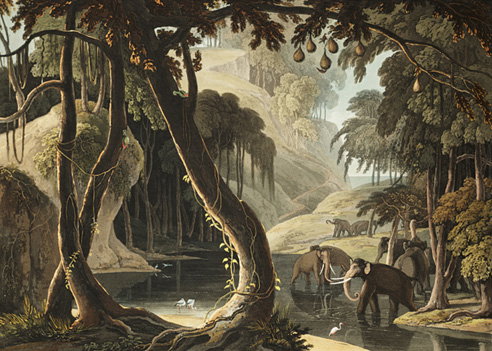
IS THERE such a thing as an elephant ghost? A ghost different to the ones Miss Tammie Ferreira sometimes sees. A ghost in my shape. For if there is, then I have seen one. Correction. I have seen four. A family. And we have communed, albeit imperfectly, me and this family of spectres. Yes, there are elephant ghosts. They are real. And I have been with them tonight. Willie and Anna slept through it all.
This is how it happened. We find ourselves camped in a field high on a bluff, overlooking the estuary and small town of Knysna. The sea booms in the far distance, hidden behind high bluffs, but the tangy smell of salt and seaweed reaches us clearly.
This field we are in is part of a farm that grows fresh and bright and temptingly fragrant green peas. But I am warned sternly, by just about every human in the encampment, that stealing the peas will do our tenure here no good. So I abstain, though with great difficulty, for as we all know, I could easily uproot this puny stake from this febrile earth, and saunter through those fields at midnight, relieving my appetite this night, every night, any night I might chose to do so. But one consideration that overrides all others is my concern for Willie. I’d hate for him to get into trouble on account of me. And I am led to understand that perhaps the greenery from these plants, once stripped of the green pearls within, may have offered me as forage in the future anyway. So I’m happy to wait. Well, let’s say prepared to wait.
The townsfolk will come out to our show here. The paddock is lush and green, bounded on one side by the railway that brought us here, on two opposite others the pea fields, and on the last by dense forest — real vaulting forest, not the widely-spaced thorn tree scrub as so often seen in this land. They are tall, dense podocarp trees (Willie told me that’s what they are, called yellow woods, a fact gleaned from his latest reading, a novel which happens to be set in these parts).
Our first show, part of a week scheduled here, will be tomorrow night. So apart from all the usual activity of setting up camp, there is none of that tension-to-deadline that occupies the air so completely in the close countdown to the lifting of the curtains.
We’re sitting around an informal dinner. A fire is working up a pile of glowing coals. Blue smoke envelops us, swirling in the light breeze. People suck at beer bottles. Miss Tammie is almost relaxed, and joshes with Sproetjies the clown, the one who is actually a short and square-faced woman behind the make-up, and who rides the small pink tricycle with the off-centre wheels. Tammie makes a show (as she does with everything) of riding it and Sproetjies, despite herself, finds something to laugh at in this. So does Willie. His chuckle has an idiom all of its own. Anna looks up only briefly from the hand repairs she is doing on a sequined waistcoat that is worn by one of the performing dogs.
Miss Ferreira does a wobbly clown impersonation and spills from the trike. She kicks it away, in the same manner the clowns do to keep the wheels spinning and lies with legs and arms stretched stiffly upright. Then looks around for affirmation, waggling her eyebrows, flipping her head from side to side to take in both halves of the audience. Almost a slick performance, which is then marred by her ripe expletives — “Vokken moer!” — when she regains her feet in an agile backbend flip and discovers the faded checked man’s shirt she has been wearing, a favourite of hers and of mysterious provenance, has been plastered on the back with a zebra’s turd. The laughter from the sidelines now takes on a genuine edge. Even Anna is tempted to look up again, and a sly smile spreads across her face.
The fretful Miss F stalks off into a fog of her own swearing which swirls about her face like a cloud of miggies, the miniature mosquitos we are often plagued with in humid places like this. She’s back ten minutes later, and surprisingly with no grudge evident in her scent or self about the recent loss of dignity. Perhaps she has tallied it against the temporary achievement of a greater popularity.
She rejoins the drinkers, after taking a length of boerewors sausage in a hollowed-out quarter loaf of white bread, filling the space around it with potato crisps, and smothering it with a peppery tomato and onion sauce. This culinary abomination is a regular on nights like this. It’s our humans’ standard catch-up dinner. She’s careful to contain the slop in a large enamel plate, white with a blue rim. Sproetjies hands her a beer, and normal transmission resumes. Again, surprisingly for Tammie, she settles into the crowd and allows someone else to take centre stage. It’s Frik this time, with a meandering story about how a nephew of his has become a ducktail, a city swell, frequenting roadhouses and dance halls, cruising the streets in a gaudily customised Ford Falcon, wearing a constant cigarette, tight black trousers and a greasy hairstyle that tapers to a point down the back of his neck. “It gets him the girls,” is Frik’s sad punchline. He sounds almost envious of his young nephew We wish for slapstick again.
And so the evening wears down into a kind of quietude, golden light shafting between the angled posts of the tents and flashing off caravan windows in a final sign-off before disappearing. The clink of bottles being tossed into bins as they heap up. The smell of boerewors sausages grilling on a slow fire, the smoke wafting into every bit of canvas we have stretched above us. It’s one of those nights where — more than most — this collection of tents and caravans and carriages and odd individuals, humans and others, actually feels like home — a real home.
Willie and Anna drift back to our carriage. I was to have been tethered tonight outside the big tent, but somehow Willie neglects this chore. He has done this occasionally before, and more commonly now that Anna is with us. It’s of no consequence. I’ll do what it takes to keep him out of trouble. I’m not going anywhere. And I’ll stay away from the peas. Promise.
So I just stand silently in the spot where people would expect me to, while everyone drifts off to sleep. James, our night watchman, stokes the cooking fire, pokes at the ashes to get a small flame going again, and settles next to it in a creaking deck chair. He stares at the fire, unmoving, a knobbed stick across his knees, shoulders hunched in his thick coat, a small-brimmed hat pulled low down over his ears. Only his grizzled beard is to be seen. Generators are stilled one by one around the camp, and the lights go out, until just the glow of the fire remains to define the watchman’s silhouette. The rhythm of sleeping descends. I can sense regular breathing from so many mouths around me, it creates a softly syncopated symphony, punctuated by the muted rattles of different snores. Our camp at night — unexceptional. Before midnight, the watchman is comfortably asleep too. His snoring is the loudest.
As if to take over vigilance from the watchman, a half-moon levers itself over the wall of trees at the edge of the forest, and floods the open spaces with muted silver light, strong enough to cast a soft shadow. A large owl flies silently across the moon’s face and is lost again when it dips below the dark fringe of the trees. A farm dog barks distantly.
A soft, inexplicable tug comes to me. It insists. It impels me to that forest edge. Who am I, if not to follow? So I do.
Of course I can move silently, we all can, so my gliding through the camp passes unremarked upon by anyone — least of all the watchman. A couple of zebras flubber their lips softly at me, and stomp once, twice, sounds that are so soft and familiar as to invoke no response.
I approach the line of trees, and the unspoken tug weakens. So I pause and wait.
The shadows appear. There are four of them. They step half out of the tree cover and stand still again. We stare silently at each other. They are elephants, yes, but of so quiet a manner they could be spirits. They are all female, a full family: matriarch (she is slightly in front), a sister, daughter and calf. The older three carry short, thin tusks.
It is the calf that speaks first. “You…” is all the little one can manage. Or something that sounds like that, as if in a language I had forgotten I knew. Perhaps I imagined it.
The matriarch silently turns her head and swings her trunk sideways in an unequivocal command of silence. She turns back to me to continue staring. There’s an unsettling intensity in that gaze. The others shuffle sideways into her sides, one pinning the calf between their legs, to make a single enclosed form. One shadow. Four lives. Eight eyes. The matriarch’s ears tremble almost imperceptibly at their edges, almost as if they were flicked by the wind, but I know the movement comes from within. That tremble at the same time betrays her and comforts me.
“Who…” I venture, whispering.
She simply shakes her head silently. Our intense scrutiny continues, seemingly forever. It is they who are in command of time here. And time seems to respond. It stops too. The four, stand immobile, and so do I.
I feel it is I who is trespassing. I attempt an explanation. But where to start? “I work with these people. We travel. We do shows. We will not stay here long. We will be gone in a few days. We are always moving.” It sounds inadequate.
There is no response from the silent four. The focus of their gaze suddenly shifts to something beyond me. I turn to follow that stare.
A man appears from one of the caravans a hundred paces behind us and takes a few steps out over the wet grass. He stops, braces himself with legs planted wide apart, and reaches into his trousers. An arc of steaming piss is lit by the moon. A miniature man-made one-colour rainbow. The man leans backward gazing at the sky, groaning with unabashed pleasure.
The four stiffen but remain utterly still and quiet. The man shudders in the cool night air, wraps his arms around his bare chest and returns to his caravan, stamping his feet on a wooden box placed on the ground as a step. The door clunks shut. The caravan rocks briefly as he flops back into bed.
I turn back to the four. “We mean no harm. He doesn’t know you’re here.”
I know this must make no sense to them. Again, no immediate response comes from them.
Then the matriarch begins to say “Your…” Or a word that may sound like this. She trails off into a continuation of that silence that seems to be their natural state. I’ve wondered for a while now what she was going to say. I don’t think I’ll ever know.
Into this void of communication, I try again, speaking carefully and softly and in a measured way. “We may be of one kind. But this I do not know for sure. It’s just a guess.” And, gesturing back to the sleeping circus, “There are no others like me back there. But here you are.”
Their scent reaches me. It has motes that I could recognise from my own but has also a clear separation. There are some elements parallel, others simultaneously divergent. We could be one. We are decidedly not. But mostly, they emit suspicion and confusion. I wonder if I do too, to them.
I am almost entirely unused to interaction of this kind. I have little practice in it. Once, for a short time many years ago, there were another two elephants with me in the show. They were named Oomie and Tess. We travelled together for six months. Mostly they snarled at me, demeaned me, and held close to themselves. They remained dominated by a cruel trainer who had clearly abused them over an extended period. His habit of coercive correction by pressing the burning end of a cigar into our skins, or his enthusiastic use of a spiked pole to move us about, his aggressive barking of commands — that was what defined his character. As for Oomie and Tess, they were more broken than me.
They held to themselves. It was all they could do. Theirs was a jealous orb of being, and it would never extend to including me. Oomie would rise up on his back legs and place his heavy front legs on my back. Sometimes he could press me to the ground in this way. He seemed to take a perverse delight in this torture. The man built it into our act. It was humiliating. Beyond the basics, we didn’t talk much. At least I don’t remember that. How I wish, now, that we could have. But they, all three of them, seemed ever distrustful of me. And consequently, I was of them in return.
They — Oomie, Tess and the trainer — left abruptly one sweltering December day. I can remember them being swallowed up by another train, and how it pulled away with irrevocable disinterest. There has been so much in my life that I have had no choice in changing.
The diminishing perspective of the receding train was mirrored in the way I almost instantly deleted them from my files of experience. You don’t remember what you don’t want to. There’s no need to harbour more anguish than you have to.
Willie joined us the very next day. Or so it seems to me now. Time compresses from this vantage looking back. Or does it simply stand still, to be punctuated by sharp moments that inscribe our memories, as plough may scratch futilely at an unyielding earth? Or as a train may rattle over a level crossing and disappear into an anonymous day.
Willie immediately replaced Oomie and Tess in my emotions, washed them away — not that they ever had much place there anyway.
I have been lost in my private reverie. I look up, to see the four still there, still silently staring at me. The present intrudes. The moon comes out from behind a small cloud to remind me of this. The owl makes a return pass.
I have forgotten my manners. “They call me Tant-Meisie. That is the name they have given me. I have no idea what my real name might be.
“I have never been here before. This field, this stopping place, I do not know. What is your place in this place? Do you work with people too?” This is obviously incomprehensible to them. They have no reaction. Nothing.
A pinprick of moving light catches my eye from the edges of peripheral vision. The lights of a lone post-midnight car, moving slowly, sweep across and caress the pea fields. For some minutes I watch the car progressing steadily, curving away from us, until the lights are lost behind a stand of trees. They flick into sight again, then are lost as the road dips behind a low hill. The distant rumble of the motor persists a little while longer, then fades completely. The owl calls once, startlingly close by.
On the dark horizon beyond and even further away, a veld fire makes a tiny, prickly, animated orange necklace. Like imaginary jewels in another world.
I turn back. The four are gone. They have melted into the folds of the night. More silently than they had stood there. Were they ever actually there? Were they just a hallucination?
No, they were real; they existed as physical beings in physical space — of that I am sure. And their disappearance is just as solid in its completeness. And yes, I do take those ten steps forward to take in their scent again, to see their footprints in the soft, dewed grass. Not ghosts. An indelible memory. I stand there for some time, then turn back to our camp, and my place in it. Again, I am left alone and the circus holds the only place for me.
Do you work with people too? I recall myself asking of them as I wander slowly back to my place by the tent, and fully aware of how ludicrous it would seem to the four not-ghosts.
Who were they? I will never know.
*
Before we leave this camp, overlooking this lagoon squeezed between two mountain-shoulders, Willie and Anna take a day off to explore the town.
They return with a postcard bought at the only store that will allow their trade in the main street of the town, one selling newspapers, exercise books and such-like.
“There were elephants here once,” says Anna. “But the volk around here say they’re all gone. Or are perhaps still hiding in the forest.”
She shows me the card.
“See, they look just like you.”
And I have nothing to say.